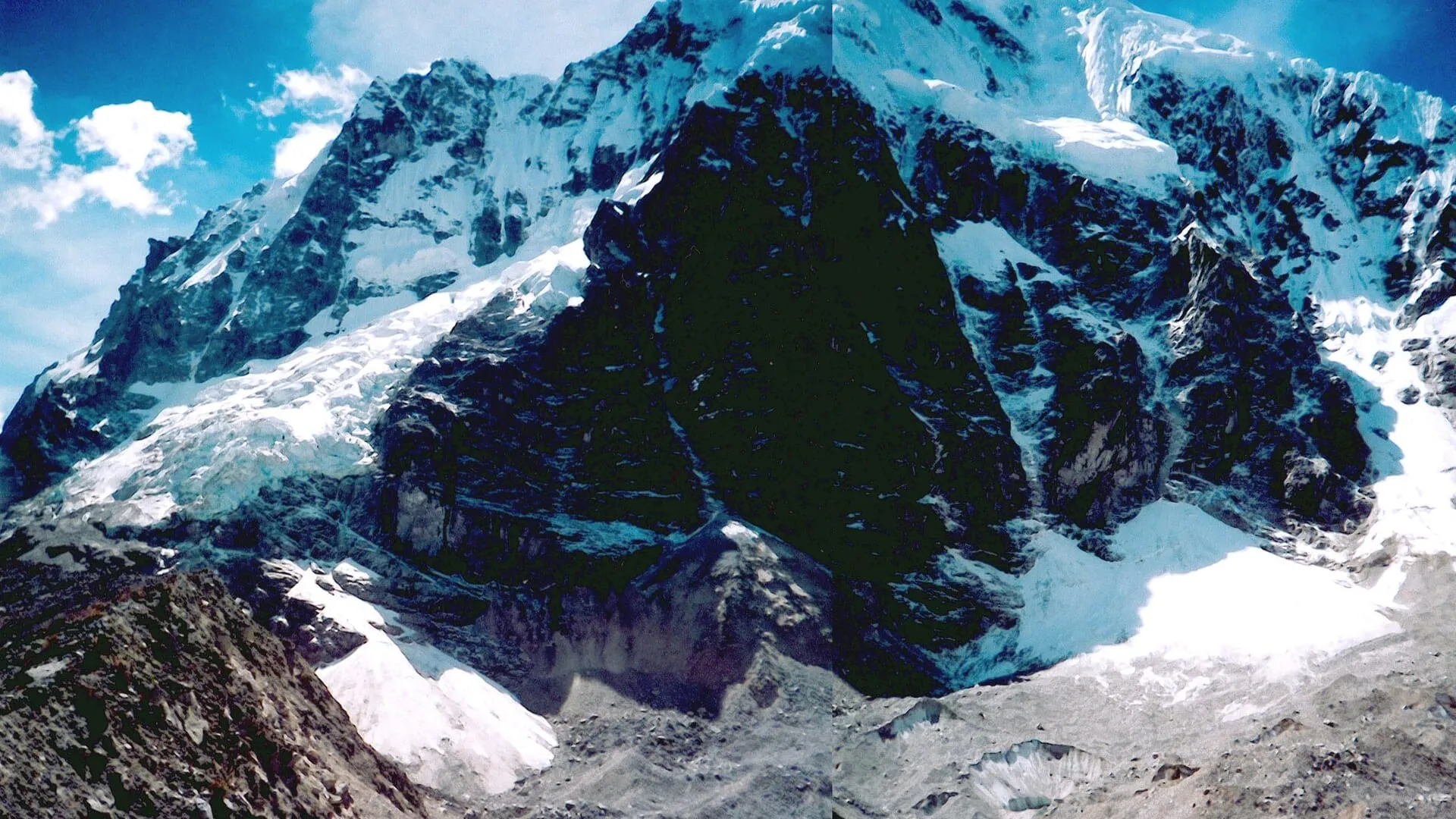
Salkantay Trek — 5 days
From glacier to cloud forest around Mount Salkantay. No permit or quota required.
- Duration
- 5 days / 4 nights
- Difficulty
- Challenging
- Maximum altitude
- 4,630 m
- Group size
- Maximum 14 people
- Departures
- Daily departures
- Acclimatisation needed
- 2 days in Cusco
- Best season
- April to October
An alternative route to the Inca Trail, circling Mount Salkantay. It requires no permit or quota, has daily departures and can be booked at a few days’ notice.
The route descends more than 2,500 metres over five days: it begins at a high camp facing the glacier, with below-freezing temperatures overnight, and ends in cloud forest among coffee plantations and tropical vegetation. It crosses more ecological zones than any other trek in the region, which means carrying gear for both temperature extremes.
The most demanding day is the second, crossing the pass at 4,630 m above sea level, the highest point in our catalogue. The final nights are spent in a guesthouse in Aguas Calientes before entering Machu Picchu.
Itinerary
Day 1
Soraypampa and Humantay Lake
Transfer from Cusco and acclimatisation hike to the glacial lake. First night at high camp.
4,200 m above sea level
Day 2
Salkantay Pass
The most demanding day. Climb to the pass at 4,630 m with the peak straight ahead, then a long descent towards the cloud forest.
4,630 m above sea level
Day 3
Down into the cloud forest
The landscape changes completely — coffee plantations, banana trees and orchids. Optional hot springs at Cocalmayo in the afternoon.
2,100 m above sea level
Day 4
Hidroeléctrica – Aguas Calientes
Walking alongside the railway to the town. Night in a guesthouse with a hot shower and a bed.
2,040 m above sea level
Day 5
Machu Picchu
Early bus up, guided visit of the citadel and return train to Cusco.
2,430 m above sea level
What's included
- Outbound transport and return train from Aguas Calientes
- Machu Picchu entrance ticket
- Certified professional guide
- Pack horses for shared equipment
- Tents, sleeping mat and dining tent
- All meals except those listed
- Cook and first-aid kit with oxygen
Not included
- Sleeping bag (available to rent)
- Trekking poles (available to rent)
- Entry to the Cocalmayo hot springs
- Final dinner in Aguas Calientes
- Tips for the crew
What to bring
- A 30 to 40 litre day pack
- Broken-in hiking boots
- Clothing for two climates: below freezing at altitude, humid heat in the jungle
- Insect repellent for the lower section
- Rain poncho
- Head torch
- Swimwear for the hot springs
Frequently asked questions
Does it need a permit like the Inca Trail?
No, and that is its great advantage. There is no daily quota and no booking months in advance. It can be arranged at a few days' notice, even once you are already in Cusco.
Is it harder than the Inca Trail?
It goes higher — 4,630 against 4,215 — and the days are longer. But the terrain has fewer steps, which is what punishes knees most on the Inca Trail. It is hard in a different way.
Why does the climate change so much?
Because the route descends more than 2,500 metres. You start camping below freezing at high altitude and finish in humid, warm cloud forest. You need clothing for both extremes.
Do we camp every night?
The first nights, yes. The last one is in a guesthouse in Aguas Calientes, with a hot shower and a bed before going up to Machu Picchu.
When not to go: January to March — heavy rain and landslide risk on the jungle section